President's Message

This has been quite a year; full of commemorations, presentations and fun.
We started off with a visit to St Joseph's Villa where we were invited to ring the chapel bell, which I am told can be heard for miles. We participated in the Fiber Festival at Patrick Henry's Scotchtown, Heritage Day in Louisa County and Jack Jouett Day at Southern Revere Cellars. Jack Jouett is considered the Paul Revere of the south, warning Jefferson and the Virginia legislature the British were coming. (Very exciting! Stay tuned for more to come about that later.)
A number of us attended the second annual race for Boston (Henrico's famous racehorse) at Colonial Downs. Most importantly we celebrated HCHS 50th anniversary at Wilton House Museum. Still celebrating, we participated in Glen Allen Day with our 50th anniversary balloons flying, in the parade! We also presented a display of never before seen photos of the homes and families of Short Pump at the Rassawek Vineyards Autumn Festival. Two Henrico buildings (formerly in Short Pump,) were relocated to the property of Rassawek, which coincidentally was once part of the original Henrico territory. We will finish up with participation in the "1775: Subject of Citizen" a 250th Revolutionary War commemoration event at Meadow Farm on Nov. 8th.
HO!HO!HO! In addition to all of the above, we have been celebrating Christmas all year!
Many thanks to all of you who donated books for the Henrico Christmas Mother and to Christ Lutheran Church and others who also donated bibles, upon notice they were in short supply and often requested. They are being distributed as of this message by the Henrico Christmas Mother volunteers.
We look forward to seeing you at the December 7th quarterly meeting.
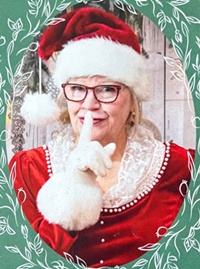
While participating in the Christmas in July book drive at Lakeside Farmers' Market, we had the very distinct pleasure of meeting Mrs. Claus With A Cause!
Mrs. Claus is very busy the month of December, but she has agreed to pay us a visit.
You are invited to share your Christmas memories, whether they are by-gone or continue to be a family tradition. And please bring some of your favorite Christmas cookies to share and swap while enjoying eggnog or a mug of hot chocolate.
Cookies can be a favorite holiday recipe (bring the recipe if so inclined) or store-bought. After all . . . Ukrops and other bakery items have become holiday tradition. Please bring enough cookies to share and swap. Bags will be provided for take-out.
Guests are welcome.
By the way, did you know? The Ukrop family began with a farm in Henrico County and founded Slovak Baptist Mission which became Poplar Springs Baptist Church.
So much history to share! Giving thanks for all of you!
Sarah Pace
President
>Back to Top<
December Quarterly Meeting
Come join us for our last quarterly meeting of the year.

Date and Start Time:
Location:
- Armour House
- 4001 Clarendon Road
- Richmond, VA 23223
A Holiday Celebration:
You are invited to share your Christmas memories and bring some of your favorite Christmas cookies to share and swap while enjoying eggnog or a mug of hot chocolate. We will also have the special treat of a visit from Mrs. Claus with a Cause, who will add a touch of magic to our program. Guests are welcome.
>Back to Top<
Dues Renewal Time

Please Take a Few Minutes to Fill Out the Attached Envelope, Write a Check, Stick on a Stamp and Join Us for Another Year of Promoting Henrico County History
If you would prefer, you can go to the society's website at www.henricohistoricalsociety.org and pay your dues on line.
If there's no envelope here, you must be one of our Life Members, a sister organization or a recipient of a gift membership.
We thank you all for your support.
And we thank our Life Members who have already invested so generously in our society.
>Back to Top<
Inventive Henricoans
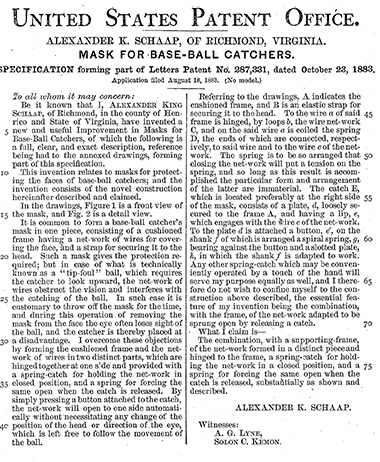
It's an iconic scene. The batter pops up a foul ball, the catcher rips off his mask, holds it as he follows the ball's arc then tosses the mask aside to field the ball. And while major league baseball has udergone many changes - time clock, larger base pads, no infield shifts, and more - that familiar sight remains.
Baseball would certainly be a bit different if Alexander Schaap's invention had caught on.

>Back to Top<
Little Westham Creek was . . . A Creek By Many Other Names
The creek name designation changed over time. Initially called Lower Westham Creek to distinguish between the creek and a smaller waterway to the west known as Upper Westham, it was later referred to as Greater Westham because it was larger than that to the west. At times, the creek is known simply as Westham Creek. Then, over time, "Lower" likely became conflated with "Lesser" and "Little" and the larger creek became known as Little Westham Creek, resulting in "Big Westham Farm" being located on what is now known as Little Westham Creek in 1832.
"Knowledge of This Cannot Be Hidden: A Report on the burying
Ground at the University of Richmond," Shelby M. Driskill, 2025
As a little boy who built dams on and caught tadpoles in a tributary of Little Westham Creek between Severn Road and East Valley Drive in the late 1950s, I didn't care about its name. It was just "the creek." Decades later, however, I find the many iterations of the creek's name interesting and a story in itself.
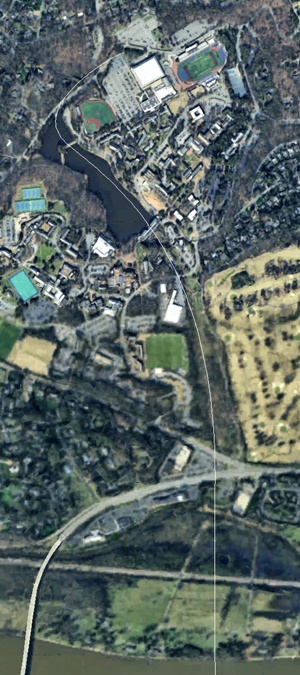
That little trickle of a creek and three others within a couple of hundred yards of each other passed through culverts under Patterson Avenue, met a short way south of Patterson and formed Little Westham Creek, which feeds the seven-acre Westhampton Lake on the University of Richmond campus.
That lake is a small part of the 1,797 acres of land granted through a 1702 patent to Giles Webb, one border of which was near "Lower Westham Creek." It is today's Little Westham Creek. When Webb died around 1713, the land went to the Randolph family. William Randolph left his land at Westham to his son Peter in 1742, who sold it to his brother William. He sold the now 5,000-acre Westham plantation to William Byrd in 1753.
Byrd sold the land to Robert Carter Nicholas, who later shared ownership with Edward Ambler. John Harvie and then his son Edwin were the next owners of the Westham property. After the latter's death, John Graham and Thomas Taylor purchased 1,400 acres of the original Westham tract. As seen on the map below, Graham kept control of the approximately 700-acre eastern portion on Big Westham Creek and kept the name "Westham," while Taylor took the land west of Little Westham Creek (Today, the westernmost creek is Westham, and the easternmost creek is Little Westham, unlike in the map below).
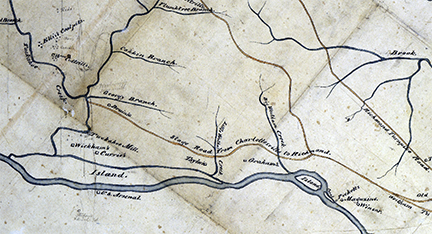
After Graham's death, his 700 acres were sold to William Shapard in 1823. He and his wife combined that land, bought additional land and called their farms "Big Westham" (the Graham tract) and "Little Westham." They lived there for over ten years before selling it. The advertisement in the 18 December, 1832 edition of the newspaper, Constitutional Whig for the sale gives an extensive description of this combination of properties.

The Crouch Brothers, Richard and Thomas, purchased the land described in the announcement above in 1833. Seven years later, they sold the land to Clement H. Read and William D. Sims, who sold the land in 1855 to Benjamin W. Green, who already owned other land in the area.
This was land Green had bought from Robert Gamble, who earlier had bought it from Spotswood Lipscombe. It appears to be the same land that Lipscombe offered for sale, describing it in the following announcement in the 22 November 1808 edition of Enquirer.
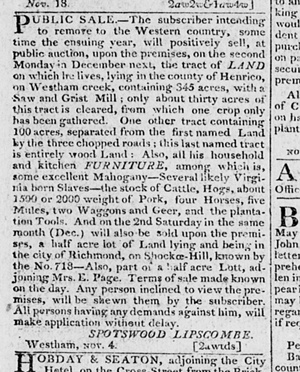
While the land is described here as "on Westham Creek," when it changes hands again, it is said to be "on the Lower Westham Creek."
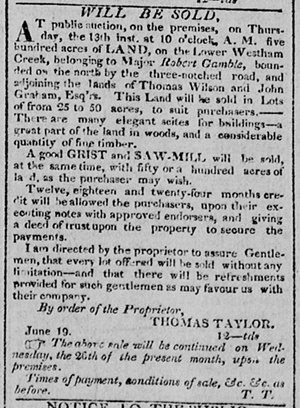
The "GRIST and SAW-MILL" in the preceding two advertisements is apparently the same "B. Green's Saw Mill" at the lower end of the body of water (now Westhampton Lake at the University of Richmond) seen on Smith's 1853 map of Henrico County. In 1848, trustees of Julia A. Green had bought a mill and a bit over 60 acres adjacent to the Westham estate on what was then called Great Westham Creek. Apparently, the purchase was in her name because of lingering legal troubles of her husband. Ultimately, Benjamin W. Green's property was seized on December 5, 1867, as the brief announcement from the 6 December 1867 edition of the Daily Dispatch below indicates.
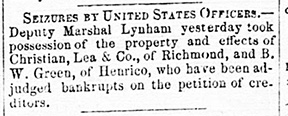
The portion of the acreage that would later include most of the Richmond College campus on the northern side of Westhampton Lake remained in the family until the turn of the century, but Westham Farm was sold by trustees in 1868 after Green defaulted on his payments for the land. At the time, the Green family had assembled over 2,000 acres, almost half of the original 5,000 acre Westham.
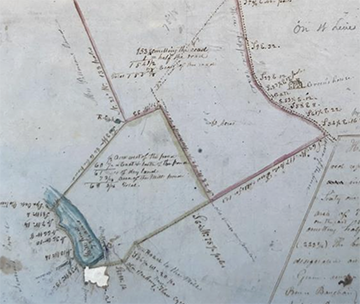
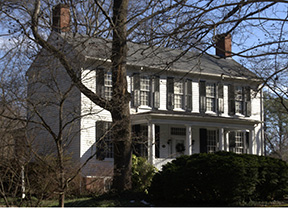
However, at the top end of today's Westhampton Lake is a section of the land that the Greens did not acquire. Apparently, Robert Carter Nicholas did not sell to John Graham. Nicholas' son, Philip Norborne Nicholas, did sell it to John Harvie. After several subsequent sales over the years, Dr. Thomas Patterson bought the land in 1836. What had been Norborne Forest became known as Paradise Farm, and the house that Patterson built still stands in the area near the University of Richmond.
The image of the 1853 plat of Paradise & Westham Farms labels the land above what is now Westhampton Lake with the words “Mrs. Patterson’s land.” It also shows Westham Farm to the right of the lake and Green’s saw mill at the bottom of the lake."
This land also had a mill on it, and it was the site of a disastrous explosion described in this article from the Daily Dispatch edition of 23 March 1876.

While Green's Saw Mill was at the lower end of the lake, the mill on Paradise Farm was above the lake to the east where today's Little Westham Creek enters it. It was known in the 1876 article as "the headwater of Westham Creek."
Over the following years, the land below this, and land on each side of and below the lake would eventually become the campus of the University of Richmond. The rest of the land that comprised Big and Little Westham Farms passed through several hands, including William Robinson Browne's True Reformers for its Old Folks Home. Today, the term "Westham" generally refers to an area a good deal smaller that what once comprised the Big and Little Westham Farms of the nineteenth century. It seems that the name "Little Westham Creek" has become its permanent name.
Joey Boehling
Shelby M. Driskill's "Knowledge of This Cannot Be Hidden: A Report on the burying Ground at the University of Richmond," at https://buryinggroundmemorial.richmond.edu/_common/reports/Burying-Ground-Report-April-2025.pdf was immensely helpful in producing this article. I recommend it to anyone interested in learning more about the area and its history.
Patterson's Paradise: This house near the University of Richmond is believed to be the house Dr. Patterson built.
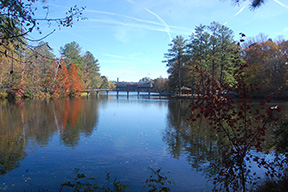
Westhampton Lake: From the upper shore of the lake on what was once "Mrs. Patterson's Land," the lake is fed by Little Westham Creek, which enters from the left and exits via the dam at the far end.
>Back to Top<
The Changing Names of Westham Creek
Smith's Map, 1853. The 1853 map identifies B. Green's Saw Mill and shows both creeks but fails to identify either by name.
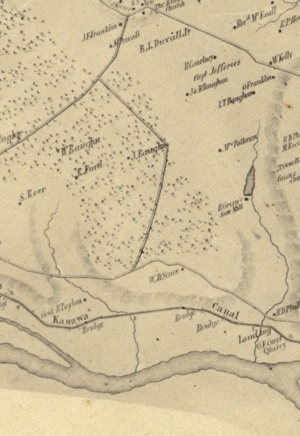
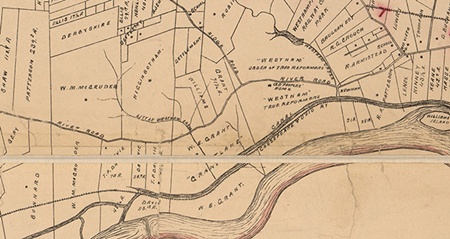
Henrico Map, 1901. The naming of today's Westham Creek and Little Westham Creek is reversed in the map below.
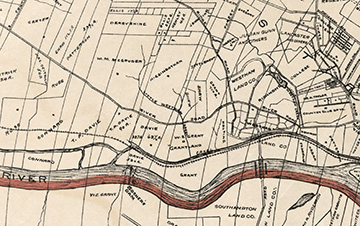
Henrico Map, 1911. The county map below shows both creeks and curiously identifies both as "Little Tuckahoe Creek."
From the Air. The aerial shot shows the path of Little Westham Creek from above Westhampton Lake to the Kanawha Canal.
>Back to Top<
Now You Know . . . Measuring Flight Time
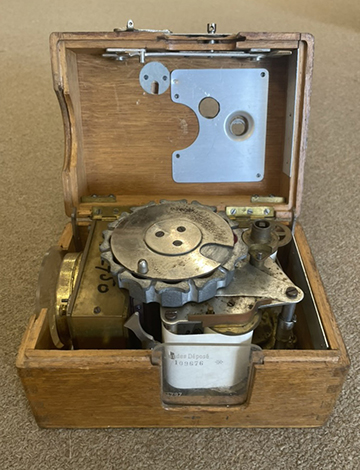
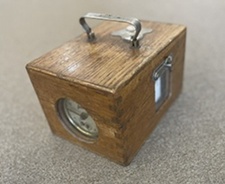
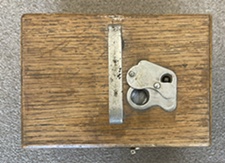
Congratulations to Haywood Wigglesworth and Nancy Grubbs for correctly identifying the What Do You Know object from the last issue as a pigeon racing timer. Because Racing Homers leave a common location but arrive at their individual home locations, each pigeon owner must have a device like that pictured to ascertain the time of the flight.
At the starting point of a race, each pigeon has a leg ring attached that has a serial number on it. The racing birds are all released at the same time, and they head for home. At home, the owner removes the ring and puts it into a timing clock through the opening seen at the top of the box. This timer is missing a key that would be inserted into the smaller opening and turned. This would turn the internal mechanism that would then print the serial number and time on the roll of paper seen in the window. The clock also retained in an internal compartment that could only be accessed by a race official. The rate of flight would be calculated by the comparative times of flight over distance flown to determine the winners.
>Back to Top<
What Do You Know?

This primitive wooden box is 13" tall, 12" wide and 4" deep. A board down the middle divides the into two equal sections.
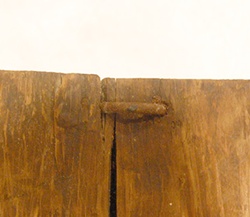
At the middle of the top top of the back is a small metal loop.
Do you know what it is?
Email your answers to jboehling@verizon.net.
We look forward to hearing from you.
>Back to Top<
News 2025: Fourth Quarter
First Quarter | Second Quarter | Third Quarter
Home | Henrico | Maps | Genealogy | Preservation | Membership | Shopping | HCHS
|