President's Message
Happy 250th Birthday America!
The New Year started off with a bang in Washington DC with the Washington Monument projecting the history of the Nation and the transformation of the Monument into a giant birthday candle. Fireworks welcomed in the 250th year of the United States of America.
The 2026 New Year's celebration was soon followed by severe wintry weather conditions.
The 250th commemoration of the American Revolution brought to mind how similar wintry conditions were endured by George Washington and his troops while crossing the Delaware River on December 25, 1776 to conduct an attack at Trenton, New Jersey. If not for their bravery and perseverance, the outcome of the battle of Trenton would have had very different results, with the success of the Revolution possibly at stake.
George Washington's audacious plan of attack included three different crossings of the Delaware River on Christmas night. One to distract the British and prevent them from supporting the defense of Trenton, the other a defensive position to prevent a retreat. Washington and his troops would cross and march to Trenton to surprise the garrison at dawn.
The plan had been threatened from the beginning. A spy in Washington's ranks had disclosed to the British a possible plan of attack on Trenton. Two American deserters crossed the river and told the Hessians that the American army was ready to move. Other British loyalists informed the Hessians that an attack was imminent. Those warnings were somewhat ignored or considered not likely to happen because of the weather.
A light rain had turned into howling wind with snow and sleet. One soldier recorded that "it blew a perfect hurricane" as snow and sleet lashed Washington's army.
Two of the crossings failed because of the icy conditions. Washington's main force managed a crossing along with its heavy artillery, ammunition and horses, but was more than three hours delayed. It took the American army roughly 4 hours to march from the river crossing site to the outskirts of Trenton. Washington later wrote, "… As I was certain there was no making a retreat without being discovered and harassed on repassing the River, I determined to push on at all Events."
Future U.S. President James Monroe, who crossed with the American forces, survived after having been wounded at the Battle of Trenton to fulfill his destiny and that of his country.
Another such exploit which had the potential of changing the outcome of the American Revolution is one that is not widely known or rather has been all but lost in time, but for local efforts. Jack Jouett rode his horse Sallie through backroads the night of June 3-4, 1781 to notify Thomas Jefferson and others in the Virginia legislature British troops under the leadership of Lieutenant Colonel Banastre Tarleton, were coming to capture them in Charlottesville. Among those who escaped were Thomas Jefferson, Patrick Henry, Benjamin Harrison, John Tyler, and Richard Henry Lee. Other sources mention the names of General Thomas Nelson Jr., Archibald Cary and General Edward Stevens. Daniel Boone was one of seven captured and briefly detained. Some refer to Jack Jouett as the "Paul Revere of the South." He later served in the Virginia and the Kentucky legislatures.
James Monroe, according to one source, would interestingly appear later in the story in recognition of Jack Jouett's deed of patriotism.
In 1940 the General Assembly of Virginia designated June 4 as Jack Jouett Day "in honor of a brave and loyal Virginian whose signal exploit will be remembered as long as men shall love true courage and noble and unselfish action." In 2001, perhaps in oversight or by intention, the General Assembly named June 3 as Jack Jouett Day "to honor the memory of this outstanding American patriot."
We hope you will join us for the HCHS March 1st meeting to learn of the amazing excavation of Swan Tavern, owned and operated by the Jouett family, conducted by Dr. Benjamin Ford of Rivanna Archaeological Services, LLC.
Virginia contributed much to the American Revolution.
While supplies last, we will be distributing the Virginia 250 Passport at the meeting. The passport features over 70 museums and historic sites throughout the regions of Virginia. Each passport is to be stamped upon visitation at the sites listed. After receiving one passport stamp, discounts apply and entry for prizes apply after 5 stamps.
Many locations have special exhibits and programming relating to the 250th anniversary. George Washington's Mount Vernon has recently reopened after renovations. Also to note, Henrico County's Meadow Farm Museum is included in the passport. Mountain Road (along which Meadow Farm Museum is located) was itself, a witness to history. Lafayette is said to have traveled this route on the way to Yorktown. Ironically the overgrown path that Jack Jouett famously rode was referred to as Old Mountain Road.
We look forward to seeing you at the meeting.
Sarah Pace
President
>Back to Top<
March Quarterly Meeting
Come join us for our first quarterly meeting of the year.
Date and Start Time:
- Sunday
- March 1, 2026
- 2:30 PM
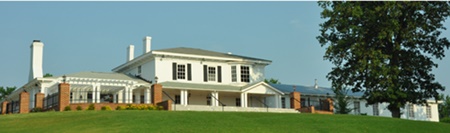
Location:
- Belmont Recreation Center
- 1600 Hilliard Rd.
- Henrico, VA 23228
Topic and Speaker:
Benjamin Ford, Ph.D.
Rivanna Archaeological Services, LLC
Dr. Ford will speak on the archaeological excavation of the former site of the historic Swan Tavern in Charlottesville. The tavern was owned by John Jouett. His son, Jack Jouett, gained fame in 1781 by riding over 40 miles through the night from the Cuckoo Tavern in Louisa to warn Virginia legislators meeting in Charlottesville of approaching British cavalry. Among those who escaped were Thomas Jefferson, Patrick Henry, Benjamin Harrison, John Tyler, and Richard Henry Lee. The young Daniel Boone was one of seven captured and briefly detained.”
See links:
Thank you to the Government of Henrico County for the photo of Belmont Recreation Center.
We look forward to seeing you there!
>Back to Top<
Dues Renewal Time

We are still collecting dues for 2026 as well as inviting anyone interested in Henrico history.
Please visit our society's website at www.henricohistoricalsociety.org to pay dues on line.
Join us and enjoy our newsletters of 2026.
>Back to Top<
Inventive Henricoans
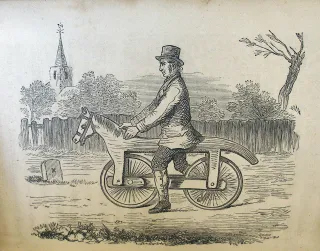
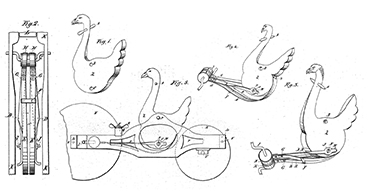
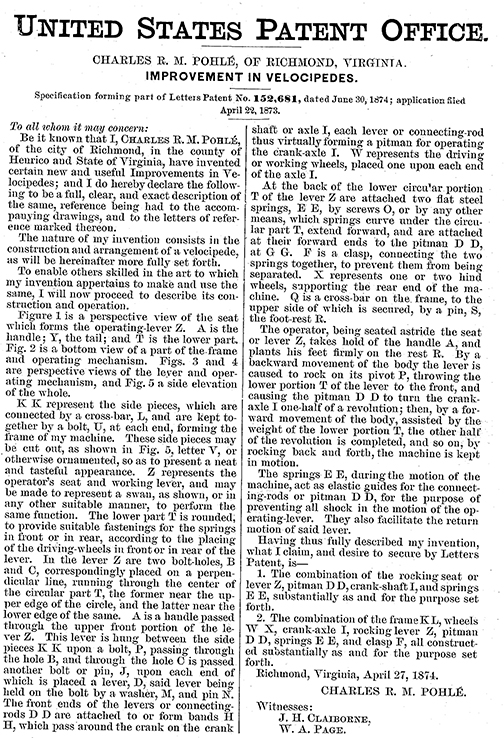
Charles R. M. Pohlé's whimsical 1873 version of a bicycle, or velocipede, seems a bit at odds with the rather dry language in the patent itself. It would have been quite entertaining to see a proper Victorian operating the vehicle, even more so than the scene created by the Englishman on the footpowered "Dandy Horse" pictured below.
>Back to Top<
Colonial and Nineteenth Century Travelers Needed Ferries . . . Where the River Met the Road
In these pages, we have traveled down a number of county roads and creeks. We've seen where they started, where they went, what they passed and what happened along the way. Of course, the creeks ran to rivers - either the Pamunkey or the James. But when early Henrico roads met the James, travel was blocked, as it was when a road in any county met an unbridgeable river.
According to Philip Alexander Bruce (Economic History of Virginia in the Seventeenth Century) the General Assembly addressed this problem in 1640, when it granted a petition from Henry Hawley, who sought to keep a ferry at the mouth of the Southampton River. It was made on the condition that it would only cost each passenger a penny. And shortly thereafter (1641-43) it established free ferries, requiring a levy by each county to provide remuneration for each ferryman in that county (counties connected by a ferry would share the cost equally). However, county courts were soon empowered to establish ferries where they were deemed absolutely essential and to determine rates.
In 1673, the General Assembly established free ferries again and appointed commissioners to designate appropriate places for ferries. In Henrico, the ferryman's wages for twelve months were two thousand pounds of tobacco. In 1696, Henrico had two ferries, one at Varina that seems to have operated only on Sundays and days on which justices convened, and one at Bermuda Hundred (now Chesterfield County). Ferry keepers were allowed to charge fees, which were three shillings and six pence for a man and a horse and one shilling for a foot passenger.
By the Eighteenth Century, the importance of ferries had grown as the following 1702 enactment illustrates:
Be it enacted . . . That all the men attending on the said ferry boates shall be free of publick and county levyes and from all other publick services as musters, constables, clearing high wayes, being impressed . . . and shall have their lycence without any fee or reward.
Additionally, the operator was entitled to license an ordinary without a fee for the license; and if he did so, no one else could open an ordinary within five miles of it. Moreover, it seems that anyone not a ferryman who charged to take someone across a river where a ferry was available would be subject to a five-pound sterling fine to be split with the informer unless the person was crossing to go to church.
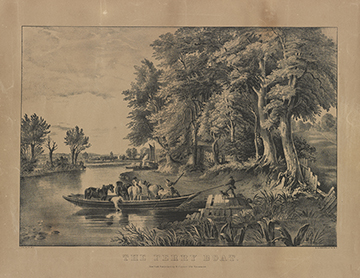
Ferries remained vital to trade and travel across the James River in Henrico County through the nineteenth century, despite the 1788 opening of Mayo's Bridge in Richmond and the access it provided to the south side of the river, and ferries and landings could be found on both sides of the river below the city. On pages 4-5 you'll find a selection, nowhere near exhaustive, of Henrico ferry sites and some of the things that happened at them.
Pictured is Fanny Palmer's mid-nineteenth century Currier & Ives engraving depicts a typical ferry of the time.
Joey Boehling
>Back to Top<
A Henrico Ferry Sampler
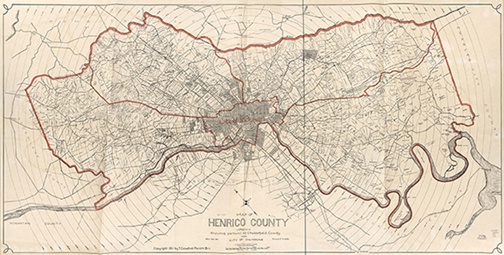
Ideally, a map is presented with a "North-up" orientation. The map details used to illustrate the different ferries here are from different maps, each one has its own unique orientation. So James Keily's 1864 Map of Henrico County with a superimposed compass rose has been included as a reference. Match the river bends in the details to the corresponding bends shown on the Keily map to get an idea of the ferry's location and of its surroundings.
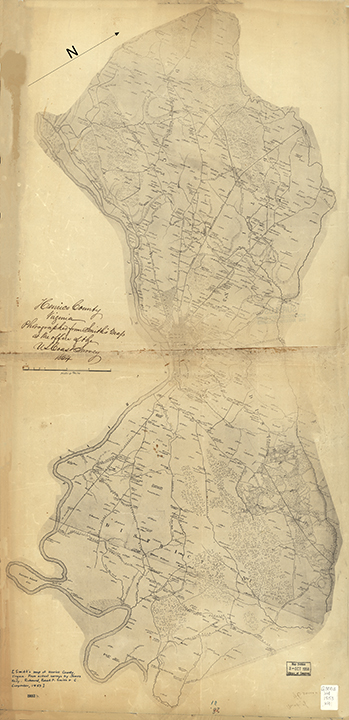
Full images of maps used for ferry details
Available at Library of Congress. URLs are in the descriptions.
Map of Henrico County, Va.: showing fortifications around Richmond, north and east of the James River. [1864] Map. https://www.loc.gov/item/2002627451/.
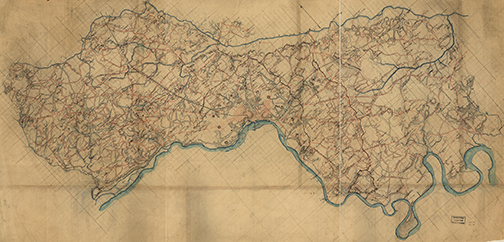
United States Army. Corps Of Engineers. Henrico, Co., Virginia, with additions showing the defensive lines and works of Richmond. [Washington, D.C., Engineer Bureau of the War Dept, 1864] Map. https://www.loc.gov/item/99448331/.
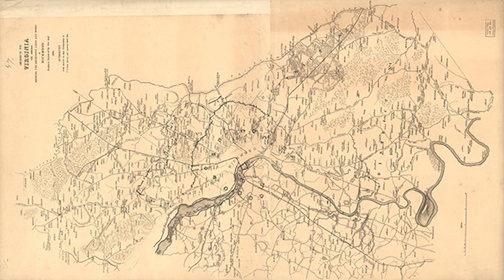
T. Crawford Redd & Brother. Map of Henrico County, Virginia: showing portions of Chesterfield County also City of Richmond. [Richmond, VA: T. Crawford Redd & Bro, 1911] Map. https://www.loc.gov/item/2011586686/.
>Back to Top<
Woodson's Ferry and Ferry Legislation
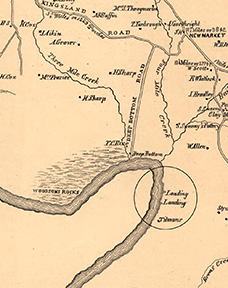
On Thursday, 8 November 1753, The House of Burgesses ordered "That it be an Instruction to the Committee of Propositions and Grievances, to whom it is referred to bring a Bill . . . for establishing a Ferry from Four-Mile Creek Warehouse Landing in the Land of Charles Woodson in Henrico County across James River, to the Neck of and belonging to Tarlton Woodson, in the County of Chesterfield."
The location of the landing is marked by the circled portion found on the 1864 Corp. of Engineers Map of Henrico fortifications.
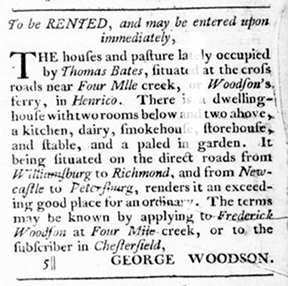
It is interesting that when George Woodson advertised "houses and pasture" for rent in 1776, he touts it as a "good place for an ordinary" because it had been made illegal to establish an ordinary within five miles of a ferry in 1702. This from the Virginia Gazette, 29 March 1776 shows:
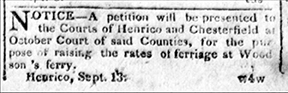
And then in 1811, raising the ferriage rate required that legislation be passed. This is seen below from the The Enquirer, 20 September 1811.
>Back to Top<
Two Excursions from Cox's Ferry
The location of Cox's Ferry Landing is seen below, which is from 1864 Map of Henrico fortifications around Richmond.
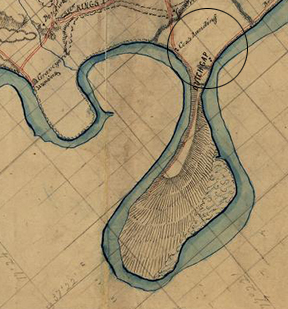
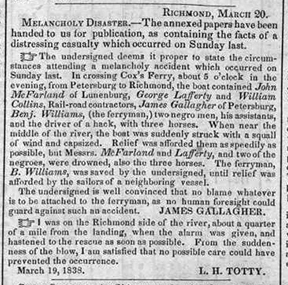
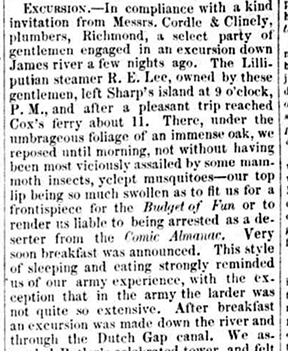
These two accounts of experiences at Cox's Landing illustrate some of the dangers of ferry travel and some of the inconveniences of stays at the landings. 1864 Map of Henrico fortifications around Richmond:
The Daily National Intelligencer, Washington, 27 March 1838 shows:
The Daily Dispatch, 19 July 1866 shows:
>Back to Top<
Ferries as Meeting Points
Another ferry was the Kingsland Ferry, the location of which is seen below.
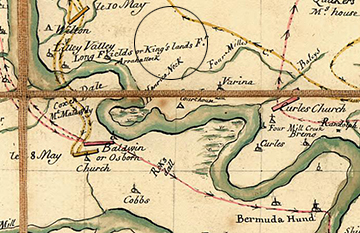
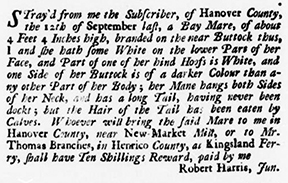
Aside from transportation, ferries served as important markers or landmarks for general directions. For example, in the Virginia Gazette edition of December 1, 1738, Robert Harris of Hanover County requested that whoever found his "STray'd" would return it to Kingsland Ferry in Henrico for a ten shilling reward.
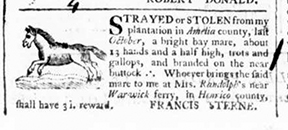
And Francis Sterne of Amelia County requested that his missing mare could be brought to Warwick Ferry, which was, it seems, then in the section of Henrico that eventually became Chesterfield.
>Back to Top<
A Short-lived, Possibly Misidentified, Possibly Never-run Ferry
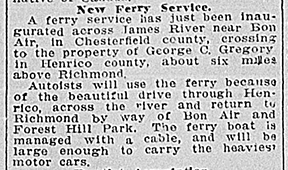
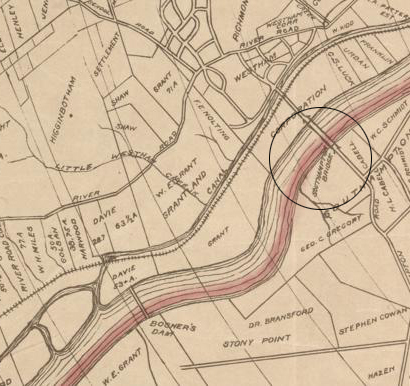
It's curious that the ferry in the article below, if it was ever put into operation, was gone by 1911, the year after the article's publication. Even more curious is that the map below identifies the Westham Bridge (the forerunner of the first and the present Huguenot Bridge) as the Southampton Bridge. That first bridge, a toll bridge, was built by George C. Gregory's Southampton Bridge Corporation. Moreover, it seems that the ferry, if it ever ran, started from Gregory's land in Chesterfield, not Henrico County since this single article from the Times-Dispatch is the only reference that could be found.
From Richmond Times-Dispatch, 9 August 1910:
>Back to Top<
Now You Know . . . It's All Just Ducky
Congratulations to Nancy Grubbs and Haywood Wigglesworth for correctly identifying the What Do You Know object from the last issue as a nesting box for ducks; the ring on the back was for hanging it (probably on a tree). Commercially produced duck boxes today are, of course, much more refined than this primitive handmade version. Ducks Unlimited, which bills itself as "the world's largest and most effective private waterfowl and wetlands conservation organization" offers the following guidelines for placing nesting boxes:
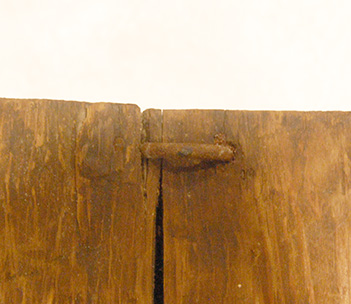
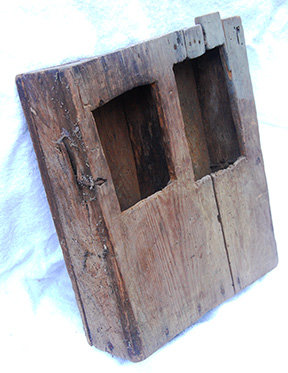
Nest boxes can be mounted on tree trunks or on steel poles beside the water or above the water.
Good placement: A dead tree at the water's edge
Better placement: A solid dead tree in the water
Best placement: Boxes on poles near standing, flooded, dead trees
Note: Live trees can be used for mounting boxes, but keep a close eye on your box. Growing trees may loosen mounts and make boxes less attractive to the birds.
>Back to Top<
What Do You Know?
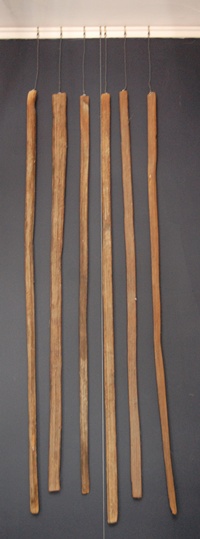
These sticks, the longest of which is 57" long, now have wire and eyelets to allow them to decorate a wall. Of course, that was not their original purpose. While they look like just ordinary old sticks, they're not - they served a very specific purpose. And the person using them needed far, far more than a mere six.
Do you know what it is?
Email your answers to jboehling@verizon.net.
We look forward to hearing from you.
>Back to Top<
News 2026: First Quarter
Second Quarter | Third Quarter | Fourth Quarter
Home | Henrico | Maps | Genealogy | Preservation | Membership | Shopping | HCHS
|