President's Message

Hear ye, hear ye!
Much is going on throughout the land to commemorate the 250th anniversary of American Independence on July 4th, 2026.
HCHS representatives have been participating at events with neighboring counties and historic sites to educate the public and celebrate the occasion. I must say, it is most impressive how those who have been "called to arms" to promote America250 have responded. A great percentage of those are volunteers, who give freely of their time (including all HCHS representatives) and expertise—historians, musicians, hearth cooking, blacksmithing, weaving, artillery demonstrations, dancing, etc. Check out the HCHS FB social media postings to view activities with much more to come.
About America250
"America250's mission is to celebrate and commemorate the 250th anniversary of the signing of the Declaration of Independence, marking America's Semiquincentennial. We aim to inspire our fellow Americans to reflect on our past, strengthen our love of country, and renew our commitment to the ideals of democracy through programs that educate, engage, and unite us as a nation. America250 will foster shared experiences that spark imagination, showcase the rich tapestry of our American stories, inspire service in our communities, honor the enduring strength, and celebrate the resilience of the United States of America." If you did not get a VA250 Passport at the HCHS last meeting they are still available at VA250 Passport.
Information on dates and locations on the VA250 Mobile Museum and more about the VA250 celebration can be found at va250.org.
Educational opportunities are made available through the America250 network such as "America's Startup," a national collegiate competition recognizing the next generation of entrepreneurs shaping our country's future selected from a highly competitive pool of student founders nationwide.
HCHS will also participate again this year in a program to encourage education on behalf of the Henrico Christmas Mother, in partnership with Lakeside Farmer's Market, the Christmas in July Book Drive. We hope you will participate by donating new children's books. There is also a request for Bibles for adult reading. Books can be brought to the HCHS June 7 meeting or to the Lakeside Farmers Market every Saturday and Sunday in July.
We hope you will join us for our June 7th meeting. As we commemorate the 250th anniversary of the American Revolution, we would also like to recognize the bravery and sacrifice of all those throughout history who have fought for freedom.
Divers have just recently found the WW shipwreck of the Coast Guard Cutter Tampa that sank in 1918 off the coast of England after being torpedoed by a German submarine. All 131 people aboard lost their life, with the tragedy representing the largest single American naval combat loss of life during the First World War. June 6 was the 82nd year anniversary of D-day during WWII.
Vince Eikmeier, a Navy veteran and singer, will honor the military service branches from our founding to the present by performing all seven military songs accompanied by a brief history of each.
Those serving during the American Revolution often had bare necessities of food and clothing.
USO Centers were first established in the 1940s to improve the morale of troops during WWII. Citizens and charities would staff and fund service centers to provide entertainment and comforts of home.
USO centers today offer aroundthe-clock hospitality for traveling service members and their families. John Shrutrumpf, also a Navy veteran, is active with the USO here in Henrico County. He will speak on the USO mission. Visitors are always welcome to HCHS meetings. Bring a friend!
Sarah Pace
President
>Back to Top<
June Quarterly Meeting
Come join us for our second quarterly meeting of the year.
Date and Start Time:
- Sunday
- June 7, 2026
- 2:30 PM

Location:
- Dorey Park and Recreation Center
- 2999 Darbytown Road
- Henrico, VA 23231
Topic and Speaker:
As we commemorate the 250th anniversary of the American Revolution, we would also like to recognize the bravery and sacrifice of all those throughout history who have fought for freedom. June 6 was the 82nd year anniversary of D-day during WWII. Vince Eikmeier, a Navy veteran and singer, will honor the military service branches, from our founding to the present, by performing all seven military songs accompanied by a brief history of each.
The songs of the seven branches of military are:

- Air Force --
"The U.S. Air Force"
- Army --
"The Army Goes Rolling Along"
- Coast Guard --
"Semper Paratus" ("Always Ready")
- Marine Corps --
"The Marines Hymn"
- National Guard Bureau --
"Always Ready, Always There"
- Space Force --
"Always Above"

USO airport centers offer around-the clock hospitality for traveling service members and their families. John Shrutrumpf, also a Navy veteran, is active with the USO here in Henrico County. He will speak on his experience and the USO mission.
We look forward to seeing you there!
>Back to Top<
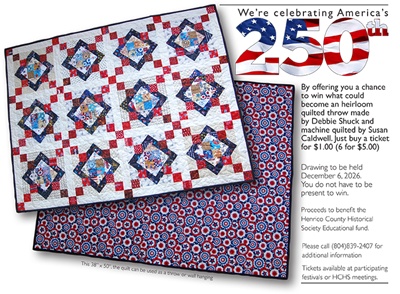
America 250th Quilt!
We're celebrating America's 250th by offering a chance to win what could become an heirloom quilted throw made by Debbie Shuck and machine quilted by Susan Caldwell. Just buy a ticket for $1.00 (6 for $5.00).
Drawing to be held December 6, 2026. You do not need to be present to win.
Proceeds to benefit the Henrico County Historical Society Education Fund.
Please call (804) 839-2407 for additional information.
Tickets available at participating festivals or HCHS meetings.
>Back to Top<
Inventive Henricoans
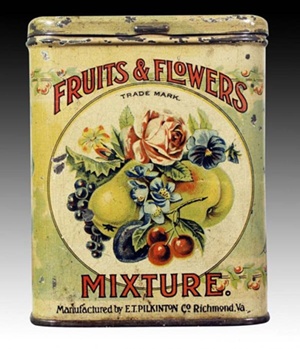
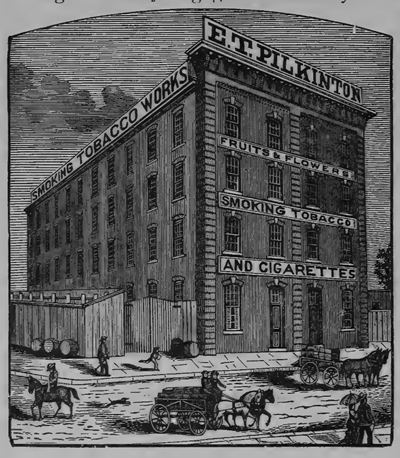
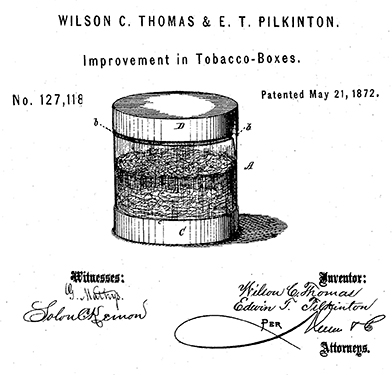
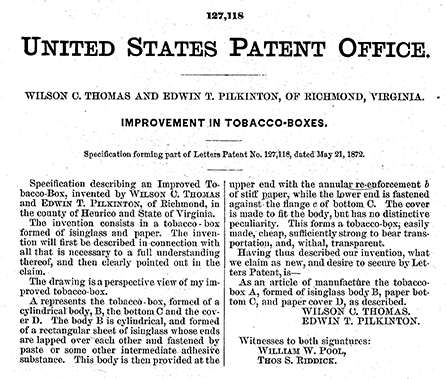
E. T. Pilkinton founded E. T. Pilkinton & Company in 1860, managing the business at 514 N. Twelfth Street in Richmond until his death in 1883. The 1886 pamphlet Industries of Richmond refers to it as "the oldest and the largest factory engaged exclusively in the manufacture of smoking tobacco in the city." His "Improvement" is a bit plainer than the Fruits & Flowers tin pictured below.
>Back to Top<
In the Earliest Days of the Colonies, Sassafras was . . . The Root of Economic Success
Looking back on the days of my youth seems to keep leading me back to Henrico County history. Recalling days spent exploring the pasture and woods of the Franklin farm on Three Chopt Road made me want to explore the history of Cheswick, the historic farm originally called Chiswick. I used to climb on the abutment on the north side of Bosher's Dam then years later wrote about that structure. Looking back on the dam-building and tadpole-catching in the creeks near my home led me to looking into the long-past events that occurred around them and will surely inspire me to research other creeks. And memories of digging in the dirt in the woods with my boyhood friends has led me unwittingly into yet another topic to dig into - sassafras.
Those trees with their mitten-shaped leaves grew in the woods that lined the creeks I played in, and my friends and I would dig up the smaller ones just so we could smell the root beer odor of the roots. Thinking we could make something like root beer, we even tried, unsuccessfully of course, to do so by boiling the roots. Now, nearly three-quarters of a century later, I'm digging into the place of sassafras in our history.
The importance of tobacco to the economic success of The Virginia Company and, therefore the colony, is well known. But until John Rolfe's sweet Trinidadian tobacco replaced the Native American strain, sassafras was, it seems, equally important. The Record of the Virginia Company of 2 August 1619 suggests the equal importance of the two products. It ordered that "all Tobacco and sasafras be brought by the Planters to the Cape marchant till suche time as all the goods nowe or heretofore sent for the Magazin [storehouse, or the equivalent of the company store] be taken off their hands at the prices agreed on. That by this meanes . . . the price thereof may be uphelde better."
According to Encyclopedia Virginia, 20,000 pounds of Virginia tobacco were exported to England in 1617 and double that in 1618. However, the quantity had not reached the level of sassafras harvested in the colony. The Records of the Virginia Company of 7 October 1622 contain a letter sent to the colony with the following directions:
Wee think it very fitt that you send home by the Abigaile 60000 weight of Sassafras, in regard she is to bring it fraight free, what shalbe made thereof assure yo'selues, shall according to or promise be returned in Armes, and Munition, or otherwise expended in fortificacon, as yorselues shall desire."
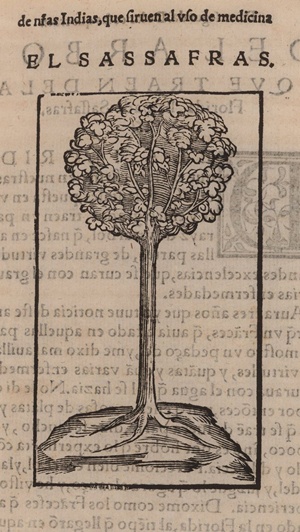
The desire for sassafras came largely from the claims of the plant's medicinal usefulness, and physician and botanist Nicolas Monardes' mid-sixteenth century Spanish publication Historia medicinal likely played a part in spurring the interest. This woodcut depicts a sassafras tree from his publication. In 1590, Thomas Hariot published A Brief and True Report of the New Found Land of Virginia in which he wrote:
Sassafras, called by the inhabitantes, a kinde of wood of most pleasand and sweete smel; and of most rare vertues in phisick for the cure of many diseases. It is found by experience to bee farre better and of more vses then the wood which is called Guaiacum, or Lignum vitæ. For the description, the manner of vsing and the manifolde vertues thereof, I referre you to the booke of Monardus, translated and entituled in English, The ioyfull newes from the West Indies."
Hariot was referring to John Frampton's translation Joyfull Newes, which claimed that sassafras could be used in the treatment of opilations (blockage of the bowel), and for "griefes of the Stomache," headache, "the grief of the stone," toothache, "those which have goute and the evill of the Joynses," "windiness" and even syphilis.
The desire for and value of sassafras were clearly great as indicated by a 1602 voyage of the Concord, which sailed from Falmouth and landed on the land that the voyagers named Cape Cod. They traded with the Indians for furs skins and sassafras; but finding their group too small to establish a colony, John Brereton, who traveled with them, wrote A briefe and true relation of the discouerie of the north part of Virginia in which he notes that the sassafras roots they brought back brought 3 shillings per pound, or 336£ per ton. In today's currency, that's roughly $130,000 per ton.
While the value of the sassafras was great, the account also hints at why the heavy harvesting of it was not really sustainable—to harvest the roots meant the death of the tree. While the Native Americans had apparently harvested small sections of the roots without killing the tree, to harvest enough for large-scale shipments meant killing the tree, thereby dealing a serious blow to sustainability.
Perhaps overharvesting was beginning to make sassafras gathering more difficult, and The Records of the Virginia Company of 1623 seem to reflect that. The company had established a penalty on "every labouring man throughout the Colony" who did not fulfill his requirement to gather 100 pounds of sassafras a penalty of 10 pounds of tobacco. However, the company altered the requirement to 66 pounds of sassafras and changed the penalty to 4 pounds of "good Marchauntable Tobacco."
Since replantable tobacco did not present such a problem, tobacco production soon far outpaced the sassafras trade. Perhaps it was royal aversion to tobacco that for a while, at least, forestalled the seemingly inevitable tobacco boom. In 1604, King James had issued A Counterblaste to Tobacco, in which he condemned "this stinking smoke being sucked up by the nose and imprisoned in the cold and moist brains," and he even instituted a 4,000 percent tax hike on it.
But by 1630, the public's demand for tobacco and the opportunity for financial gain it offered seems to have become too lucrative to ignore, and James' son Charles I issued A Proclamation Concerning Tobacco. In it he echoed his father's dim view of the weed but went on to say:
Wee have thought it worthy of Our Princely care, as a matter not only fit for Our profit, & the profit of Our people, but much concerning Us in Our honour and government so to regulate the same, and compell due obedience thereto, that Our Forreigne Plantations and Colonies may beem supported and encouraged, and they made usefull to this Kingdome.
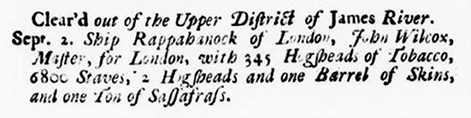
Tobacco's place in the economy continued to rise as the place of sassafras fell. A century later, the relative demand for tobacco vs. the demand to sassafras in the earliest days of the colony had been completely reversed as the brief announcement in the 2 September 1737 Virginia Gazette below illustrates:
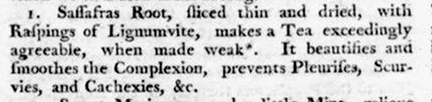
Yet it was still being touted for the improvements it was supposed to produce in appearance and health, as the announcement in the 12 January 1774 Virginia Gazette shows:
Fifty years later, Mary Randolph's 1828 The Virginia Housewife offered a recipe for another sassafras-based libation:
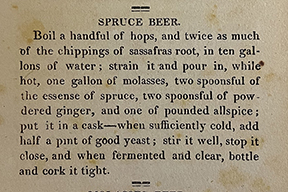
The chemical safrone would have infused those beverages with its root beer odor; and according to legend, that powerful scent first drew Columbus to the continent's shores. However, that scent today must be reproduced artificially because in 1960, the FDA found safrole to be a carcinogen and banned its use in food.
As strong as my childhood memories are, I don't imagine they will lead me to repeat my youthful experiments in brewing sassafras tea. But I can always remember the scent; and just as it supposedly drew Columbus to the shore, it carries me back to times past.
Joey Boehling
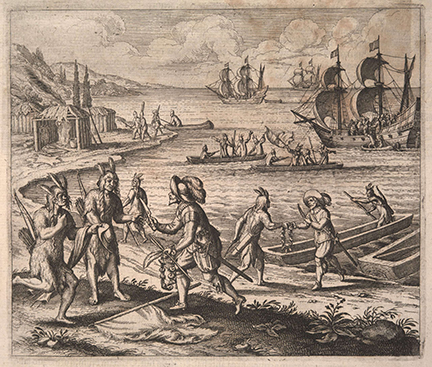
Trading with the Native Americans. The 1634 engraving by Martthaus Meridan depicts Captain Bartholomew Gosnold of the Concord trading with the Native Americans during his voyage of 1602.
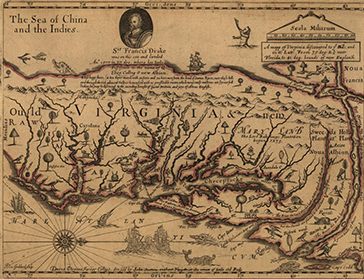
Putting sassafras on the map. John Ferrar's 1667 A mapp of Virginia is oriented with north to the right. While many trees are depicted on the map, only the sassafras tree (circled) is named, suggesting the significance of sassafras at the time. It is also interesting to note that the Sea of china was believed to border Virginia on the west.
>Back to Top<
How Colonists Weighed and Shipped Sassafras
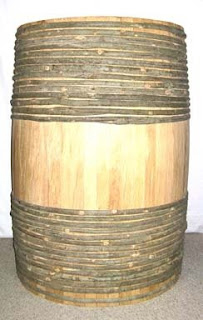
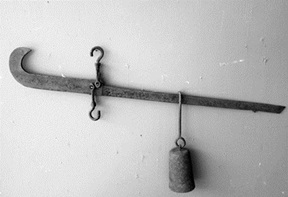
To weigh the sassafras for shipping, the colonists bundled the roots and hung them from the short arm of a steelyard (or stillyards similar to the nineteenth century example pictured below. The counterweight was slid along the arm until it balanced. The roots were then packed in a hogshead like that pictured at the left. Standardized hogsheads measured 48 inches in length, tapering to 30 inches in diameter at the head. One could hold anywhere from 400 to 1,000 pounds of sassafras roots, depending how tightly they were packed. The hogsheads could be rolled onto a ship, and the tapered ends enabled the containers to be guided and turned up on end for storage.
>Back to Top<
Now You Know . . . Curing the Leaves
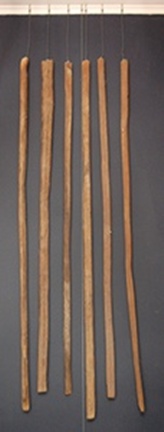
Congratulations to Ron and Nancy Grubbs, Margaret Thomas and Haywood Wigglesworth for correctly identifying the "What Do You Know?" objects in the previous newsletter as tobacco sticks.
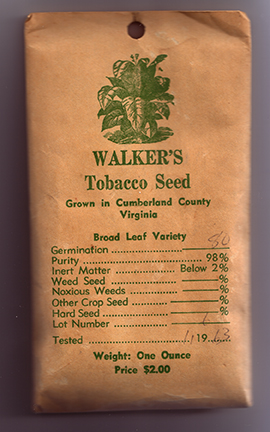
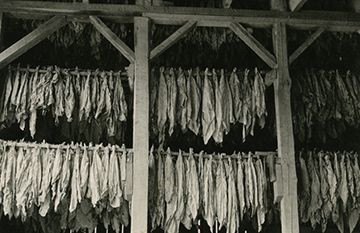
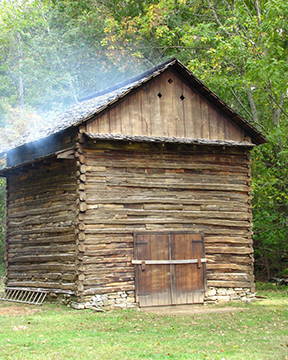
In the tobacco curing process, bundles (or hands) of tobacco were hung on the sticks, which were hung from multiple rafters in the curing barn. These particular sticks belonged to W. Benjamin Walker (1883-1964), who raised tobacco in Cumberland County and developed the Walker's Broadleaf (seed pack inset in photo). It was a dark-fired tobacco where a fire built inside the barn produced smoke to cure the tobacco.
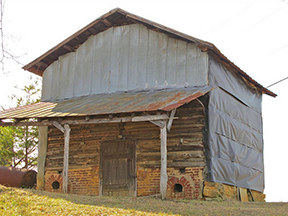
Virginian farmers also raised flue-cured tobacco, or bright tobacco. This process relied on indirect heat from the fire source to come from flues passing through the barn to cure the tobacco.
All hung up: Hands of tobacco strung on multiple tobacco sticks hang in a curing house
For dark fired tobacco: Smoke from the smoldering fire in the smokehouse curls out under the eaves as it cures house hung inside.
Flue curing: The bricked openings in the curing house below carried smoke from the low fire built inside while the heat of the fire cured the tobacco.
>Back to Top<
What Do You Know?
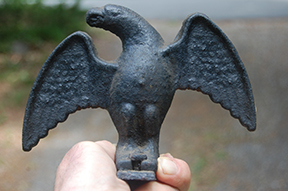
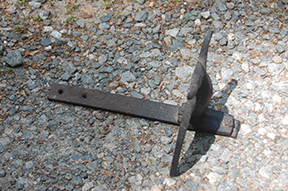
This cast iron object is 10 inches long and 5 inches tall with a wingspan of 8 inches.
Do you know what it is?
Email your answers to jboehling@verizon.net.
We look forward to hearing from you.
>Back to Top<
News 2026: Second Quarter
First Quarter | Third Quarter | Fourth Quarter
Home | Henrico | Maps | Genealogy | Preservation | Membership | Shopping | HCHS
|